Pandabuy Indoor Slippers Spreadsheet Guide
Pandabuy Indoor Slippers Spreadsheet Guide
This guide solves a specific problem: how to narrow down candidates from an indoor slippers spreadsheet, and decide whether to order based on foot shape, flooring, sole structure, and warehouse evidence. After reading, you should be able to build a candidate list, eliminate styles with high size or structural risk, and list information that needs to be confirmed with the seller or warehouse.
According to existing platform information, PandaBuy ceased operations on April 11, 2024, due to intellectual property issues. Therefore, this article cannot prove that any old links, inventory, prices, agent services, or return policies are still valid on August 27, 2026. The old spreadsheet can only serve as a resource for discovering product leads, not as a real-time catalog for direct purchase. When preparing to buy through other still-operating platforms, you should re-verify product pages, seller status, intellectual property risks, shipping line restrictions, and destination country import requirements.
This article is not suitable for people who need arch support, post-surgical recovery, certified non-slip medical use, or workplace safety footwear. For these needs, prioritize consulting professionals and choose products with clear testing standards.
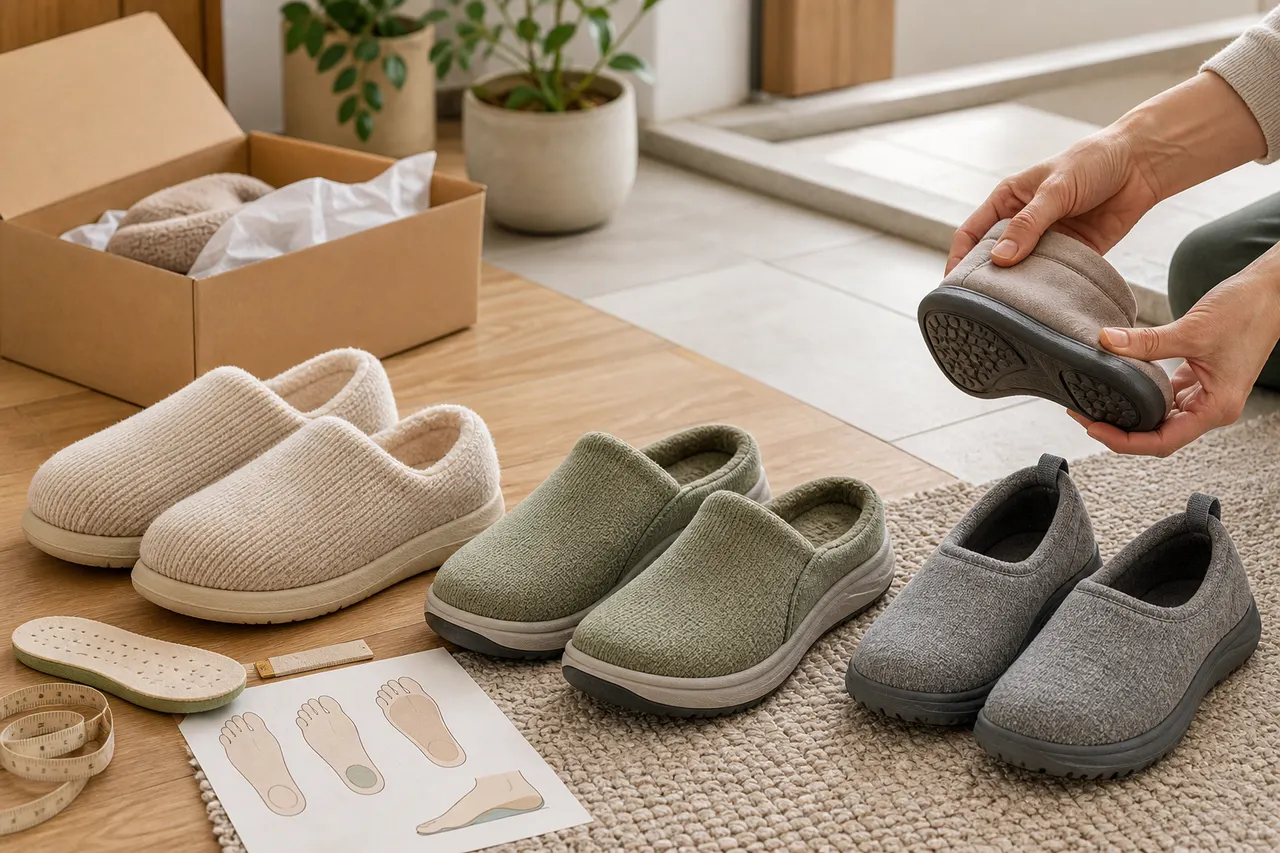
First determine the wearing space and main flooring
Don't start by picking colors or appearance. Indoor slippers must first match the usage environment, because the same pair may be adequate on dry bedroom wood floors but expose grip or water absorption issues on wet tiles. 🏠
Before ordering, record four conditions:
Main flooring: wood, tile, carpet, concrete, or mixed.
Moisture level: dry areas only, or will you enter the kitchen, just outside the bathroom, or balcony.
Wearing duration: short walks, or several hours of continuous daily wear.
Temperature needs: need warmth, breathability, or hope for all-season versatility.
If mainly used on smooth tile, prioritize finding clear sole tread patterns, sufficient ground contact area, and verifiable anti-slip information. A title claiming "anti-slip" or a sole that looks rough does not prove actual friction performance. If the product page lacks testing standards, material descriptions, or clear sole photos, mark anti-slip capability as unconfirmed.
For carpet environments, overly deep or protruding sole lugs may increase the risk of catching on carpet edges. Wood floor users should also check whether the sole may trap sand particles, and whether dark rubber has any seller-noted color transfer risk.
Build a candidate list by shoe type in the spreadsheet
The spreadsheet's role is to discover candidates, not replace product page verification. Names, images, prices, and links in the old sheet may be invalid, so each candidate should be reopened on the original product page to confirm the page is accessible and has clear product name, specifications, and visible information.
It is recommended to initially keep five to eight candidates, and record them using the same fields:
Filter field | Evidence to record | Handling when missing |
|---|---|---|
Shoe type | Closed toe, open toe, open back, or closed back | Don't judge coverage without side view |
Size | Foot length range, insole length, or shoe bed length | Ask seller if only generic sizes |
Material | Specific materials of upper, lining, and sole | Don't guess materials from images |
Sole | Tread, thickness, flex zone, and ground contact shape | Request additional photos if no sole image |
Weight | Net weight per pair or warehouse measured weight | Reweigh before shipping |
Return/exchange | Time limit, conditions, and non-returnable cases | Don't rely on return promises if terms unclear |
When filtering, don't treat spreadsheet category names as product facts. Labels like "high quality," "winter warm," or "anti-slip" should only be adopted if supported by original product information or verifiable evidence. Styles involving brand logos require separate assessment of intellectual property, shipping route, and customs risks.
Filter sizes using foot length, width, and instep conditions
Shoe size labels do not fully reflect internal space. Different sellers may use different sizing systems, lasts, and measurement methods, so start with actual foot dimensions. 📏
When measuring, wear the socks you plan to pair with, and measure standing at a time of day when feet are more swollen. Record the foot length and widest part of the forefoot for both left and right feet separately, and use the larger foot as the filtering baseline. People with high insteps should also pay attention to the height of the shoe opening, because a suitable length does not mean the instep won't be compressed.
Filtering sequence:
Find the seller's foot length recommendation, insole length, or shoe bed length, and confirm units.
Distinguish between "recommended foot length" and "insole length"; they cannot be directly mixed.
Check whether the size chart is for the current model, not a store-wide template.
Compare warehouse size labels and insole measurement photos to confirm received specifications match the order.
If only EU sizes, US sizes, or vague "runs small" descriptions are available, ask the seller for centimeter data for the current batch.
Don't apply a fixed "foot length plus a few centimeters" rule. Open-toe slippers, thick fleece closed-toe slippers, and hard molded slippers require different allowances. Without clear measurement basis, at most mark size judgment as pending confirmation, not guaranteed fit.
Compare closed-toe, open-toe, and heel structures
Closed-toe styles cover the toes and provide some warmth, but also depend more on accurate internal length, forefoot width, and instep space. Thick fleece lining may occupy internal volume; if the product page lacks insole length and forefoot information, wide-foot or high-instep users should be cautious.
Open-toe styles generally allow better heat dissipation and easier observation of whether toes extend beyond the footbed. However, if the front strap is too narrow, positioned too low, or made of too hard material, it may still pressure the instep. QC photos should show both top view and side view; otherwise, it's hard to judge strap height.
Open-back styles are easy to slip on and off, but if too small, the heel may hang off; if too large, it may increase sloppiness. Closed-back or styles with heel-holding structures depend more on heel height and opening size, and should not be chosen based solely on general slipper size experience.
A simple principle for selection:
Afraid of cold and mainly in dry areas: start with closed-toe styles, but focus on verifying internal space and lining material.
Feet sweat easily or need quick on/off: start with open-toe open-back styles, while checking strap and footbed length.
Wide feet or high instep: prioritize candidates with centimeter measurements and clear side views.
Higher walking stability requirements: don't judge by heel structure alone; also check fit, sole shape, and usage surface.
Check sole tread, flex point, and indoor use risks
Sole photos should at least include the full bottom, side thickness, and forefoot flex zone. 🔍 When only a single angled display photo is available, it is impossible to reliably judge tread depth, ground contact area, or left-right symmetry.
When checking soles, pay attention to:
Whether tread covers main contact areas, not just decorative edges.
Whether the sole has a natural flex point in the forefoot.
Whether the sole shows obvious warping, bubbles, delamination, or asymmetry.
Whether the heel and forefoot contact shapes are too narrow.
Whether left and right shoe treads, thickness, and contours are consistent.
Warehouse static photos cannot replace wet slip testing, nor prove long-term abrasion resistance. If the seller does not provide verifiable testing methods, do not use conclusions like "absolutely anti-slip" or "wear-resistant guarantee." For bathroom wet areas, stairs, or users with mobility issues, insufficient evidence itself is a reason to stop the purchase.
Flex point also cannot be judged solely by a photo of someone bending the shoe by hand. Too soft does not equal comfortable, and too hard does not necessarily mean better support. What can truly be confirmed from images is only whether the sole has obvious abnormalities and whether the structure matches the product description.
Identify evidence gaps from product information and QC photos
The product page states the seller's promises, and QC photos show what the warehouse actually received; the two cannot replace each other. 🧾 If the product page states a certain material, but warehouse photos only show appearance, the material composition cannot be confirmed from photos.
A useful set of warehouse inspections should at least cover:
Top view of both shoes, to check upper shape, color, and obvious stains.
Full sole photo, to check tread, contamination, cracks, and left-right consistency.
Side view, to check sole thickness, warping, and signs of delamination.
Close-up of size label, to verify order specifications.
Insole length or shoe bed measurement with a ruler, to verify centimeter data.
Packaging and accessories photo, to confirm whether shoebox or attachments affect shipping volume.
Image lighting, shooting angle, and screen display all affect color judgment. Without detailed close-ups, do not directly classify blurry shadows as stains, nor assume unclear issues are fine. Items that can be requested for re-photography should be written as specific actions, such as "take a vertical top view of both soles" or "measure usable insole length with a ruler," rather than a vague "check quality."
This article has not obtained specific product samples, current product pages, size charts, or warehouse QC images, so it cannot recommend a particular model, nor draw conclusions on price, materials, inventory, or workmanship. This evidence boundary should be maintained until actual verification is complete.
Verify weight, packaging, and return/exchange restrictions
Slippers themselves may not be heavy, but shoebox, padding, and outer packaging add chargeable weight or volume. After warehouse intake, use actual weight and dimensions, and estimate shipping cost based on the chosen line's billing rules. Do not speculate final landed cost from old spreadsheet prices or a single weight field.
Consolidation may reduce duplicate packaging or fixed fees, but may also increase volumetric weight, total package value, and single loss risk. Splitting may increase fixed fees but may suit different line restrictions. Without product weight, package dimensions, line billing method, destination country, and declaration requirements, it is impossible to calculate which option is cheaper.
For returns/exchanges, confirm before the warehouse inspection window ends:
When the current agent's or seller's return/exchange time limit starts.
Whether size mismatch, minor color difference, or subjective dislike can be returned.
Whether custom items, clearance items, or removal of packaging restricts returns.
Who bears domestic return shipping, service fees, and reorder costs.
What photos or measurement evidence are required for return requests.
If planning to remove shoebox to reduce volume, first confirm whether the shoebox affects return eligibility, and request to keep necessary size labels and product identification information. Any fees, policies, and shipping line status should be re-verified on the day of actual order submission.
Final check before placing order
Before ordering, use the following checklist for final judgment: ✅
Original product page currently accessible, with clear product name, specifications, and seller information.
Recorded both foot lengths, widths, and instep conditions, and used the larger foot for filtering.
Size basis comes from centimeter data for the current model, not just shoe size labels.
Shoe type suits main flooring, moisture level, temperature, and wearing duration.
Product page was not used as a substitute for warehouse physical inspection.
Planned to verify size label, insole length, sole, side view, and left-right consistency.
Unconfirmable materials, anti-slip, and abrasion resistance remain marked as unknown.
Checked current return window, fees, packaging handling, and shipping line restrictions.
If brand logos involved, separately assessed intellectual property and destination country import risks.
Price, inventory, weight, shipping, taxes, and link status re-verified on order day.
In the absence of specific weight, dimensions, line quotes, and packaging options, this guide cannot provide verifiable savings amounts; currently quantifiable savings are "not yet calculated," not zero. The main cost added by this filtering method is the time for measuring, requesting photos, and waiting for verification; risks still remain, including size deviation, images not reflecting texture, untested anti-slip performance, shipping compression, return failure, and import restrictions.
This method is suitable for ordinary indoor users willing to verify dimensions, warehouse photos, and fees before ordering. It is not recommended for those who rush delivery, cannot obtain centimeter size data, need medical or occupational safety performance, or can only rely on dead old links and blurry images.
Content note: This article was generated by the Panda-Buy Editorial Desk from an editorial perspective, organizing check steps based on existing platform background and clear evidence boundaries; it does not claim real-person purchase, wear, or testing. Specific product facts and transaction terms must be re-verified at time of use.
Agent platform shopping FAQ
1. What types of products can be browsed in pandabuy's spreadsheet?
The spreadsheet provided by pandabuy includes product categories such as shoes, clothing, handbags, accessories, sweatshirts, perfumes, hats, scarves, belts, and various household daily necessities.
2. How to judge product quality when shopping on pandabuy?
To assess product quality, refer to QC photos—do not rely only on factory-provided images, as those are often retouched. Use QC photos to confirm whether the item meets your specific requirements in details before deciding to purchase.
Additionally, remember to avoid extremely low-priced items, as they are usually of lower quality.
3. What should first-time users of agent platforms like pandabuy pay attention to?
First-time users using Taobao agent services through the pandabuy spreadsheet generally receive a new user shipping discount gift. At the same time, you should check the step-by-step shopping tutorial guides prepared for beginners.
4. What product categories are available on pandabuy?
The pandabuy website offers a wide range of product categories, including shoes, T-shirts, sweaters, hoodies, jeans, sweatpants, shorts, beach shorts, factory clearance items, down jackets, baseball shirts, shirts, hats, jewelry, bags, electronics, sunglasses, socks, underwear, and trendy collectibles.
Browse our latest products and find your next favorite item.